High Energy Density Modular Heat Exchangers through Design, Materials Processing, and Manufacturing Innovations
Project Overview
DOE ARPA-E HiTEMMP, 2019-2026:
“High Energy Density Modular Heat Exchangers through Design, Materials Processing, and Manufacturing Innovations”
Extended for two years via the ARPA-E Plus-Up program to address Oxiperator development, which is a way of oxidizing essentially all volatile organics in air streams (e.g., from lean-burn engines) through a combination of combustion aided by heat recuperation.
Executive Summary:
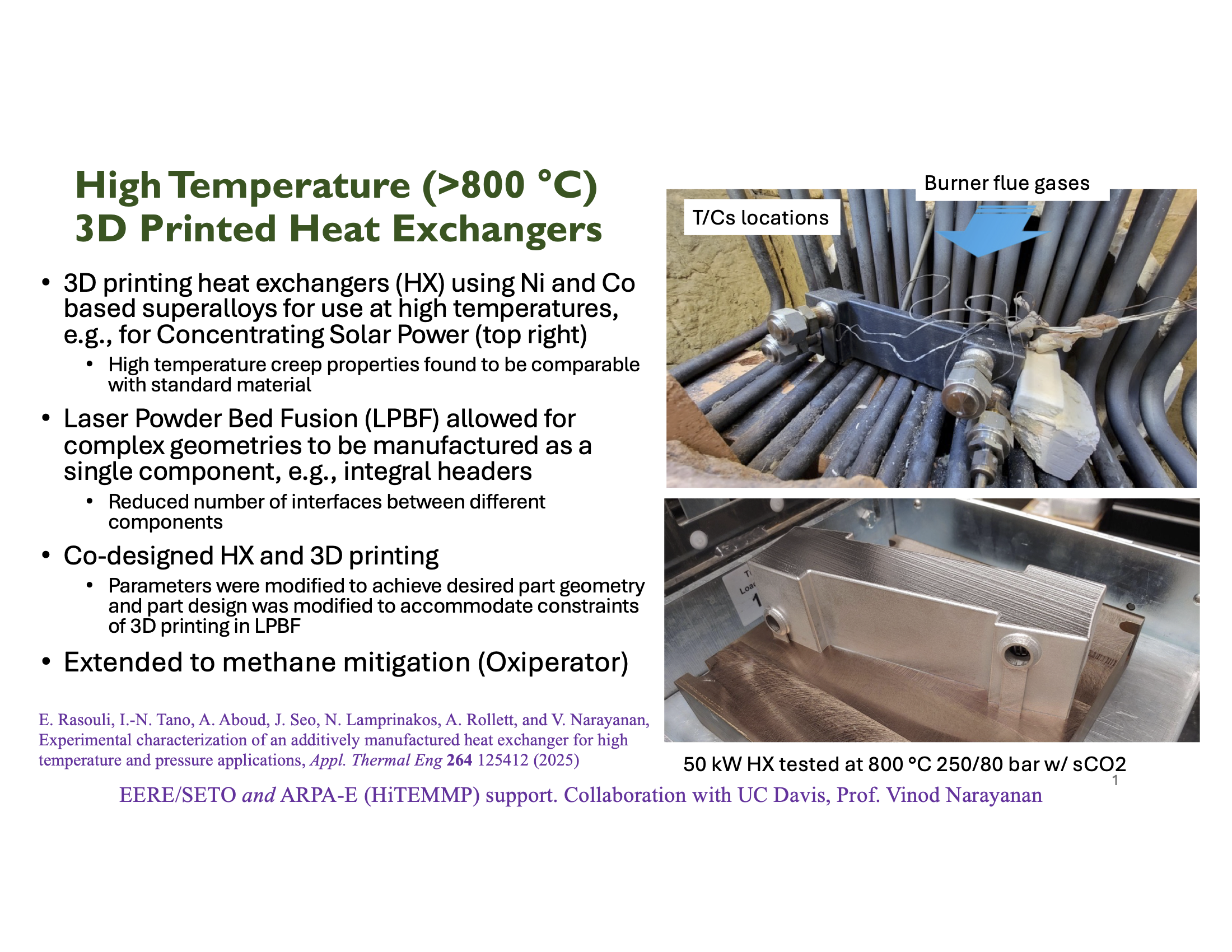
A comprehensive approach to the development of high-temperature and high-pressure heat exchangers (HX) through multi-disciplinary research in (i) material science and engineering, (ii) advanced manufacturing, (iii) heat exchanger design modeling, optimization, and experimentation and (iv) cost modeling, is proposed. A novel modular radial HX architecture that includes flow through diverging pin arrays and branching channel counter-flow headers is proposed. The hypothesis is that such HXs will result in a compact low-pressure drop design that is amenable to cyclic operation at high temperature and high pressure. The HX will be fabricated via laser powder bed fusion (LPBF) additive manufacturing (AM) with superalloys similar to those used in single crystal turbine blades, i.e., selected for maximum high temperature capability. At least two different alloys with the required high temperature capability will be tested; the main task is to identify process parameters that will allow HXs to be printed with sufficiently low defect content. Two different technologies will be used to minimize surface roughness inside the HX so as to maximize efficiency, namely abrasive flow smoothing and electrochemical machining with inserted electrodes. The application focus of the project is on recuperators for the supercritical CO2 (sCO2) cycle, although the design can be readily modified for use in other applications. We propose to advance the technology from a TRL 1 to a TRL 4 while aiming at transitioning the technology to industrial partners. The team has several industrial partners from OEM down to a small start-up business in scale.