Institute for Model-based Q&C of Additive Manufacturing (IMQCAM)
Project Overview
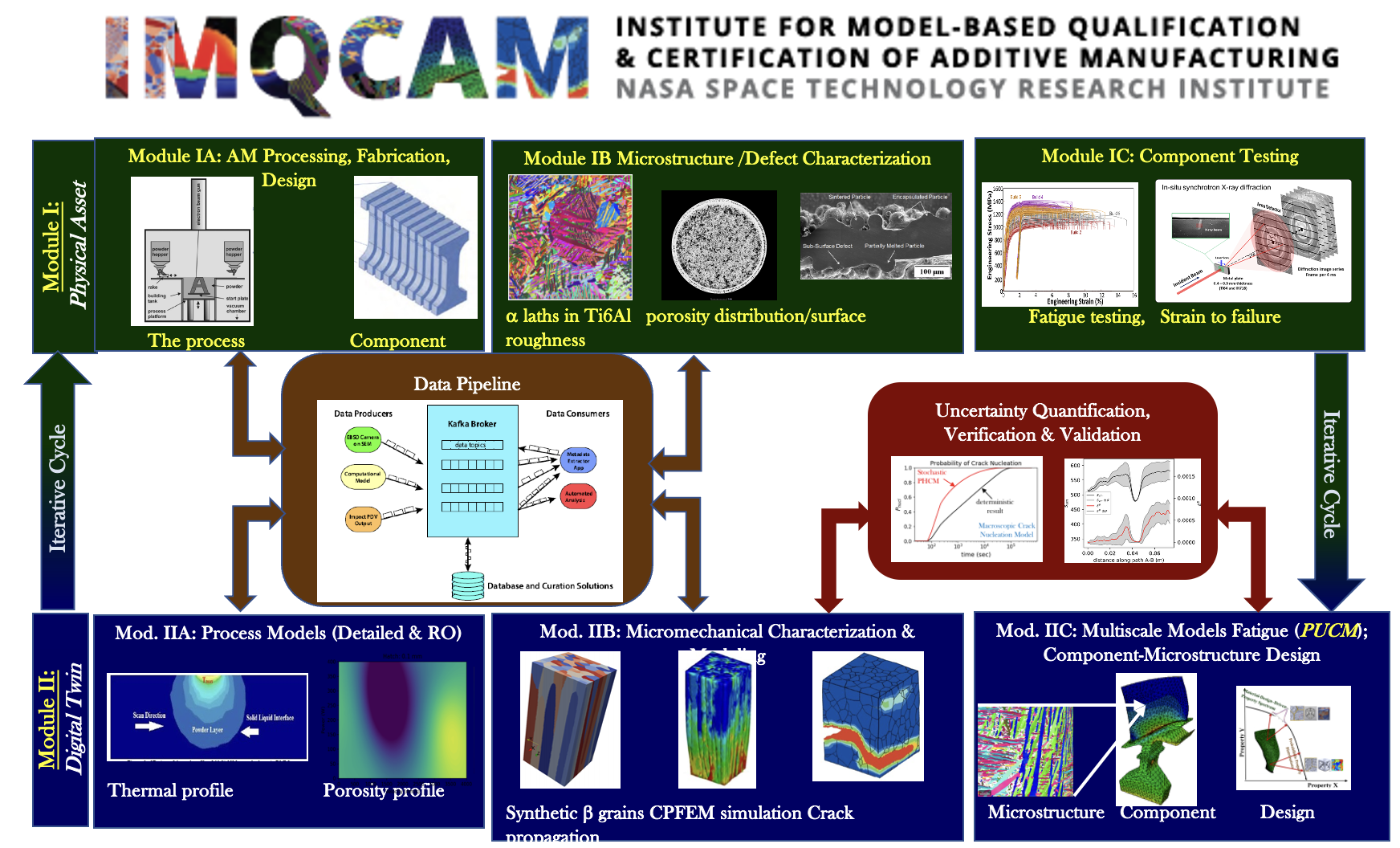
The central goal of our proposed STRI is to innovate a model-centric workflow that closes the critical gaps between current capabilities and what is necessary for efficient qualification and certification (Q&C) of parts by metals additive manufacturing (MAM), meeting NASA standards. To accomplish this, it will build and implement a visionary Digital Twin (DT) of the MAM physical asset as a certifiable surrogate for a model-based Q&C process. The DT is expected to bring a paradigm change in the current MAM Q&C practices undertaken by NASA researchers and practitioners.
The DT platform will comprise an integrated set of verified, experimentally-validated, uncertainty-quantified (V&V/UQ) computational models and simulation & design tools that will mirror the entire materials-processes-structure-property performance and life (MPSPPL) linkage in MAM. It will promote a holistic, cradle-to-grave model-based approach for unraveling the complex subtleties in MPSPPL linkages leading to improved material and process design to meet the Q&C challenge. Such a comprehensive software-enabled workflow has the potential to offer a much broader range of probes than what can be afforded by experiment- focused approaches. The requirement to link together and integrate multiple component models into the workflow, along with V&V/UQ and data management necessitates a tight- knit team working within an Institute. The team brings diversity in terms of the researchers, participation by a minority-serving institution and Institute-wide programs for involving budding scientists from under-represented groups. Innovation and integration will be a cornerstone of the STRI, with world-class researchers who are leaders in their respective fields. For achieving the challenging Q&C goals, the DT will be supported on six pillars represent- ing foundational modules of research and implementation. The pillars represent innovative thrusts in (i) fabrication, process modeling and design incorporating physics-based models as well as data-driven and ML methods; (ii) methods of material and defect characterization; (iii) multiscale mechanical and fatigue testing; (iv) physics-based micromechanical modeling methods of statistically-equivalent representative volume elements (SERVEs) incorporating material microstructure and defects (bulk and surface), (v) multiscale modeling of fatigue failure bridging materials and component scales, integrating physics-based as well as data-driven and AI/ML methods, and (vi) advanced uncertainty quantification (UQ) and verification and validation (V&V) protocols. A structured data management and integra- tion system will assimilate and support these pillars. The modular approach will integrate elements of these pillars to attain the stated objectives. Furthermore, a software integration framework will seamlessly integrate the softwares associated with each module into the DT. Such a comprehensive workflow can only be achieved through the intricate collaborations in an integrative infrastructure that is facilitated by an institute, and hence the STRI, as op- posed to a collection of single-PI projects. This multi-institutional, multi-disciplinary STRI, led by co-directors Rollett (CMU) and Ghosh (JHU), will use a wide range of modes of integration, taking advantage of modern communication platforms and technologies.
A specific focus of our STRI will be on low/high cycle fatigue life of additively manufactured parts made of Ti-6Al-4V and IN718 alloys. With respect to lifing models of MAM the current state-of-the-art (SoA) involves macroscopic fatigue life prediction from known flaw distribution and long crack growth characteristics using, e.g., Paris law. Some variants have included microstructure information in the form of micro-textured regions (MTR) of Ti alloys in macroscale FE models for predict high stress locations. Typically, the details of microstructure and defects, as well as variable cyclic loading are not included in these models. With respect to process history leading to material microstructure, the current SoA offers a wide range of computational capabilities targeted on specific aspects such as laser-metal interactions with vapor plumes, fluid flow in the melt pool, melt pool dimensions, powder spreading, heat flow in individual tracks, heat flow by layer, thermal history, stress development and defect evolution, etc. Microstructural evolution is modeled at multiple scales with varying degrees of fidelity in grain structure and phase morphology. Most approaches have however, not tied these modules into a cohesive, goal-oriented capability.
The DT-based Q&C in our proposed STRI will substantially boost the current SoA through a validated end-to-end workflow with quantified uncertainty that starts with MAM process parameters and feedstock data to predict relevant microstructural features and defects, from which the material micro-scale deformation and crack evolution response re- sponses are derived. Micromechanical simulations in conjunction with ML will form the basis for developing parametrically-upscaled constitutive models of component scale fatigue failure. This is a game-changer in multiscale modeling bridging microstructural descriptors with macro-scale behavior. The models will predict distributions in fatigue life, tying its substantial spread to process and materials variability, coupled with variations in loading. The DT will incorporate the initiation and short crack growth phases of fatigue life, typically overlooked in conventional approaches. The DT-based approach will allow design engineers to explore the phase space of factors that influence printer performance and the materials that emerge in printed parts in a far more general fashion than the conventional cost- and time-constrained approaches. By working with our external partners to validate the DT, the codes will find broader use and impact in the aerospace community.
The STRI team brings substantial prior experience and expertise in areas relevant to the DT. Their cutting-edge research contributions in rigorous physics-based and AI/ML- enabled data-driven multiscale models, combining Computational Mechanics & Materials Science, Integrated Computational Materials Engineering (ICME), Multi-scale Modeling & Design, will be advanced with an eye to high-throughput simulation. Advanced methods of V&V/UQ will be concurrently woven across all models and simulation tools. Instantiations of the DT will be built on a data-rich framework of MPSPPL relationships for MAM on which experimental data from real parts can be added. The MPSPPL modeling will be endowed with unique knowledge from the team’s experience base that informs, calibrates and validates many aspects of the materials modeling. Unique strengths acquired through the previous ULI in terms of gathering data, an already developed database of AM processing- microstructure-properties, and experience with application of ML and computer vision will be harnessed. The DT will be extensible to all materials relevant to MAM.
A major emphasis of our STRI will be on the recruiting and training of students and post-docs to have a comprehensive understanding (both modeling & experiments) of the MAM Q&C process and be the future leaders in the field. They will be mentored by the appropriate parts of the STRI team, as well as by NASA researchers in this STRI. Joint, peer- reviewed journal and conference papers with be authored and presented at major conferences and workshops. Learning opportunities will prepare students to effectively transition from academic to professional life. They will interact with collaborators from industry and NASA to realize the direct impact of their work on applications and facilitate technology transfer.